

This chocolate ganache recipe makes a smooth, glossy mixture of dark chocolate and cream that you can pour over a cake, spread as a frosting, whip into a filling or roll into truffles. It needs four ingredients and about 15 minutes of work, and the only thing that changes from one use to the next is the ratio of chocolate to cream.
The recipe card below makes about 400 g (14 oz) of pourable ganache, enough to glaze a 9-inch (23 cm) cake. Active time is 15 minutes, and the ganache then needs about 35 minutes to cool to a pourable consistency, so plan on 50 minutes in total. For other uses, the ratio table further down tells you how much more chocolate to add.
A ganache that splits or turns grainy is almost always a temperature problem, not a chocolate problem. Below you will find why this chocolate ganache recipe works, how to choose the chocolate, how to fix a broken ganache, and how to store and reuse what is left over.
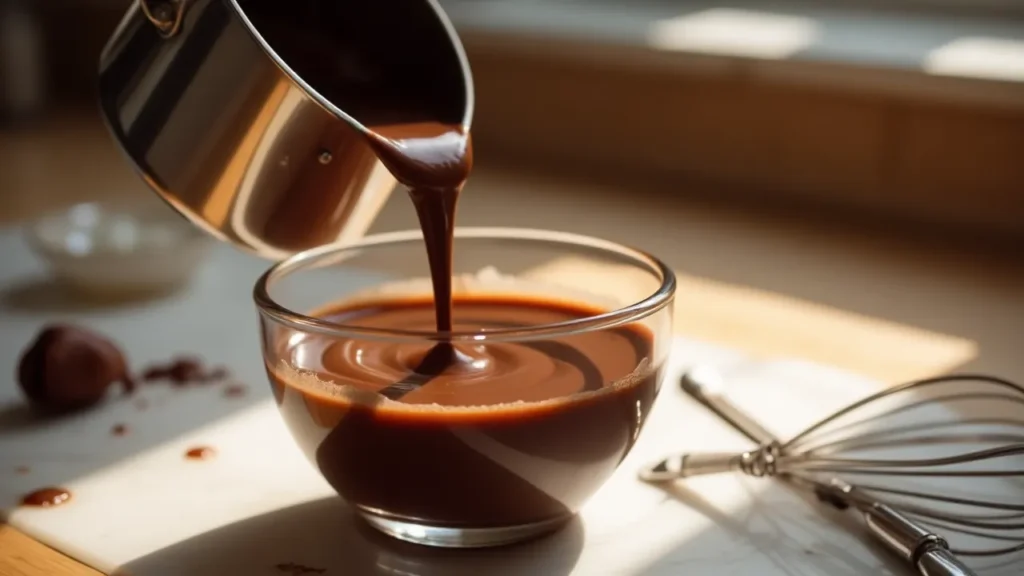


Chocolate Ganache Recipe
Ingredients
Method
- Chop the chocolate. Chop the chocolate finely, into pieces about the size of a lentil, and put it in a heatproof bowl with the pinch of salt.
- Heat the cream. Heat the cream in a small saucepan over medium heat until it steams and small bubbles form at the edge, about 80°C (175°F). Do not let it boil hard.
- Pour and wait. Pour the hot cream over the chocolate, making sure every piece is covered. Leave it for 3 minutes without stirring.
- Stir until glossy. Stir from the center outward in small circles, keeping the spatula low, until the ganache is smooth and glossy. Stir in the butter and the vanilla.
- Cool to the right texture. For a pourable glaze, leave the ganache at room temperature for about 35 minutes, until it is about 35°C (95°F) and thick like honey. For a spreadable frosting, leave it for 1 hour 30 minutes to 2 hours, stirring from time to time.
- Use it. Pour it over a completely cooled cake set on a wire rack, and let it set for 30 minutes.
Notes
What is chocolate ganache?
Ganache is an emulsion of chocolate and cream. Hot cream melts the chocolate, and gentle stirring blends the cocoa butter and the water in the cream into one smooth, stable mixture. It is a staple of French pastry, and its origin is told in several versions; you can read the background on the Wikipedia page for ganache.
The same two ingredients give very different results depending on the ratio. Equal weights of dark chocolate and cream make a soft ganache that pours when warm and sets to a fudgy texture. Two parts of chocolate to one of cream make a firm ganache that holds its shape. That is why this page has a ratio table instead of one fixed recipe.
If you want a full cake built around this method, my chocolate ganache cake uses it on a one-layer chocolate cake. This page is about the ganache itself.
Why this chocolate ganache recipe works
- Equal weights of chocolate and cream (1:1): this is the classic pourable ratio. It is soft enough to glaze a cake and sets enough to slice cleanly.
- Cream heated until it steams, not boiled: at about 80°C (175°F) the cream melts the chocolate completely. Boiling cream can scorch, and it is hotter than the chocolate needs.
- Finely chopped chocolate: small, even pieces melt at the same speed. Large chunks stay solid in the middle, and that is what tempts people to reheat the bowl.
- A three-minute rest before stirring: the heat does the melting, so you stir less and add less air.
- Small circles from the center: the emulsion starts in the middle and widens outward. Fast whisking adds air bubbles and can make the ganache look dull.
- A little butter and a pinch of salt: the butter adds a soft shine and the salt sharpens the cocoa flavor.
Ingredients and substitutions
Four ingredients carry this chocolate ganache recipe, and the quality of the chocolate decides the flavor.
- Dark chocolate (200 g, 7 oz): a bar with 60 to 70% cocoa, chopped finely. Chocolate chips work, but they are made to hold their shape in baking, so the ganache can come out thicker and a little less glossy.
- Heavy cream (200 ml, about ¾ cup plus 1 tablespoon): choose cream with at least 35% fat. Whipping cream with 30% fat also works but sets softer. Milk or half-and-half is too thin and will not set.
- Unsalted butter (1 tablespoon, 14 g): optional, for shine. Use it at room temperature.
- Fine salt (a pinch): it makes the chocolate taste more of chocolate.
- Flavorings (optional): 1 teaspoon of vanilla extract, 1 teaspoon of instant espresso dissolved in the hot cream, or 1 tablespoon of liqueur stirred in at the end. Liqueur adds liquid, so do not use more than 1 tablespoon.
- Dairy-free option: full-fat coconut cream at the same weight. The ganache will taste of coconut.
Chocolate-to-cream ratios by use
These ratios are by weight, and 1 ml of cream weighs about 1 g. They are starting points: cocoa and fat content change from brand to brand, so adjust by 10 to 20% if the result is too soft or too firm.
| Use | Dark chocolate : cream | Milk chocolate : cream | White chocolate : cream |
|---|---|---|---|
| Pourable glaze or drip | 1 : 1 | 1.5 : 1 | 2 : 1 |
| Spreadable frosting, cooled | 2 : 1 | 2.5 : 1 | 3 : 1 |
| Truffle centers, chilled | 2 : 1 | 2.5 : 1 | 3 : 1 |
| Whipped filling, chilled and whipped | 1 : 1 | 1 : 1 | not recommended |
Milk and white chocolate contain less cocoa solid and more sugar and milk, so they need more chocolate per unit of cream to set. White chocolate is the most delicate: it splits easily if the cream is too hot.
Equipment
- Kitchen scale: ganache is a ratio, and weighing is more reliable than cups.
- Serrated knife and cutting board: a serrated knife shaves a chocolate bar into small, even pieces quickly.
- Heatproof bowl: glass or ceramic keeps the heat in while the chocolate melts.
- Small saucepan: to heat the cream. A microwave-safe jug works too, in 30-second bursts.
- Silicone spatula: it stirs gently and scrapes the bowl clean.
- Instant-read thermometer (optional): to check that the cream is about 80°C (175°F) and the glaze is about 35°C (95°F) when you pour it.
Tips for a smooth, glossy ganache
These are the habits that matter most in a chocolate ganache recipe.
- Weigh both ingredients. A small difference in the ratio changes the texture a lot.
- Chop the chocolate finely. Pieces of about the size of a lentil melt in a few minutes without extra heat.
- Heat the cream until it steams and small bubbles appear at the edge. A full boil is not needed, and boiled cream is harder to control.
- Pour over all the chocolate and wait 3 minutes. Make sure every piece is covered, so it melts evenly.
- Stir from the center outward in small circles. Keep the whisk or spatula low in the bowl to avoid air bubbles.
- Add butter and flavorings after the ganache is smooth. Butter melts into the warm ganache and gives shine.
- Cool at room temperature, not in the fridge. The edges of a chilled bowl set first and the ganache turns lumpy.
How to use chocolate ganache on a cake
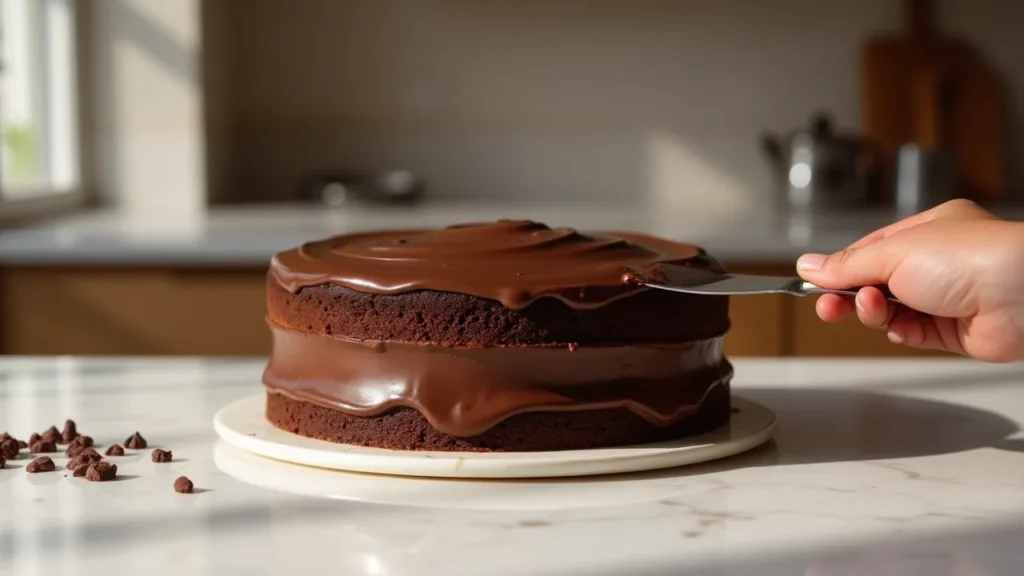
As a pourable glaze
Let the 1:1 ganache cool for about 35 minutes, until it is about 35°C (95°F) and thick like honey. Set the cake on a wire rack over a tray, pour the ganache over the middle and let it run down the sides. It sets in about 30 minutes. This is also how I glaze a bundt cake, as in my lemon bundt cake recipe.
As a drip
Cool the ganache for 10 minutes longer than for a glaze, so it is thicker. Spoon it along the top edge of a cold, chilled cake and let it run only part of the way down the sides.
As a spreadable frosting
Either use the 2:1 ratio, or leave the 1:1 ganache at room temperature for 1 hour 30 minutes to 2 hours, stirring from time to time. In a hurry, chill it for 30 minutes and stir every 10 minutes. Spread it with an offset spatula; dip the spatula in hot water and wipe it dry to smooth the surface.
As a whipped filling
Chill the 1:1 dark version of this chocolate ganache recipe for about 1 hour, until it is cool and thick, then whip it with a hand mixer until it turns lighter and holds soft peaks. Stop there: over-whipped ganache looks grainy.
As truffle centers
Use the 2:1 version of this chocolate ganache recipe, chill the ganache for about 2 hours until firm, then scoop it, roll it into balls and coat them in cocoa powder. The full method is in my dark chocolate truffles, and the same ganache covers my chocolate truffle cake.
Common problems and how to fix them
| Problem | Likely cause | Fix |
|---|---|---|
| Grainy or oily ganache | Cream too hot, stirred too hard, or the chocolate overheated | Stir in 1 to 2 tablespoons of warm cream, then blend gently with an immersion blender or whisk until smooth |
| Ganache too thin | Too much cream, or it is still warm | Cool it longer at room temperature, or stir in 30 g of melted chocolate at a time |
| Ganache too thick or hard | Too much chocolate, or it was chilled | Warm gently over a bowl of hot water, or microwave for 5 seconds at a time, and stir in 1 tablespoon of warm cream |
| Lumps of unmelted chocolate | Pieces too large, or the cream was not hot enough | Set the bowl over a pan of barely simmering water and stir until smooth |
| Dull surface | The ganache cooled too fast, or it was stirred too hard | Warm it gently and stir in a teaspoon of soft butter |
| Skin on the surface | The ganache was left uncovered | Press plastic wrap directly onto the surface while it cools |
| Air bubbles | Whisked too fast | Stir slowly, tap the bowl on the counter, and let the bubbles rise |
Variations
Once the basic chocolate ganache recipe works for you, it is easy to change.
- Milk chocolate ganache: for a glaze, use 300 g of milk chocolate with 200 ml of cream. For a frosting, use 500 g.
- White chocolate ganache: for a glaze, use 400 g of white chocolate with 200 ml of cream. Heat the cream a little less, to prevent splitting.
- Espresso ganache: dissolve 1 teaspoon of instant espresso in the hot cream before pouring it over the dark chocolate.
- Orange ganache: warm the cream with the zest of 1 orange, leave it for 10 minutes and strain it before using. Orange and dark chocolate go together very well.
- Mint ganache: stir in ¼ teaspoon of peppermint extract at the end. Taste first, because peppermint is strong.
- Liqueur ganache: stir in 1 tablespoon of orange liqueur, rum or amaretto after the ganache is smooth.
How to serve chocolate ganache
Pour the warm ganache from this chocolate ganache recipe over ice cream, or use it as a dip for strawberries, bananas and pretzels. Spoon it between cake layers, or into baked cupcakes with a piping bag. A thin coat of ganache also works as a topping for baked goods like my chocolate frosted donuts.
For a clean slice on a ganache-covered cake, use a long, thin knife dipped in hot water and wiped dry between cuts. Let the cake stand for about 15 minutes out of the fridge, so the ganache softens and does not crack.
How to store chocolate ganache
- Room temperature: up to 2 days, covered, in a cool room. Press plastic wrap onto the surface.
- Fridge: up to 5 days in an airtight container. It will set firm, so soften it before use.
- Freezer: up to 3 months in an airtight container. Thaw it overnight in the fridge.
To reuse cold ganache, warm it in 10-second bursts in the microwave, stirring in between, or in a bowl over a pan of hot water. Stir in a spoonful of warm cream if it looks thick. Do not heat it quickly: it can split again.
Leftover ganache is useful: roll it into truffles, stir it into warm milk for a rich hot chocolate, or spread it on toast.
Chocolate ganache recipe FAQ
What is the best ratio for a chocolate ganache recipe?
For a pourable glaze, use equal weights of dark chocolate and cream (1:1). For a firmer frosting or truffles, use two parts of dark chocolate to one part of cream (2:1). Milk and white chocolate need more chocolate than that, as shown in the ratio table above.
How do I make chocolate ganache for a cake?
Pour hot cream over finely chopped chocolate, wait 3 minutes, and stir gently until smooth. Then cool it: about 35 minutes for a glaze, or about 2 hours for a spreadable frosting. Pour or spread it over a completely cooled cake.
Can I use chocolate chips for ganache?
Yes, but the result is slightly thicker and less glossy, because chips are designed to hold their shape when baked. A chopped chocolate bar melts more smoothly.
How do I fix a split or grainy ganache?
Stir in 1 to 2 tablespoons of warm cream, a little at a time, and blend gently with an immersion blender or whisk until it comes together. Splitting is usually caused by cream that was too hot or by stirring too hard.
Can I use milk instead of cream?
Milk does not have enough fat to give a ganache that sets, so the result stays thin. For a lighter option, use whipping cream with 30% fat and expect a softer set.
How long does chocolate ganache take to set?
A 1:1 ganache thickens in about 35 minutes at room temperature for a glaze, and sets firm in 2 hours or more. In the fridge, it sets in about 1 hour, but stir it every 10 minutes so the edges do not set first.
Can I freeze chocolate ganache?
Yes. Freeze it in an airtight container for up to 3 months, thaw it overnight in the fridge, and warm it gently, stirring, before using.
More chocolate recipes to try
- Chocolate ganache cake: a one-layer chocolate cake under a glossy ganache.
- Dark chocolate truffles: the 2:1 ganache rolled in cocoa.
- Chocolate truffle cake: a dense cake with a rich ganache coating.
Happy baking! — Hassoun